Cancer in Children
Neuroblastoma Explained for Parents
## **What it is neuroblastoma, how it is treated, and what families should know**
Hearing that your child may have a tumour is frightening. The medical terms, scans and treatment discussions can quickly become overwhelming. This article explains neuroblastoma in straightforward language, while recognising that every child’s situation is different.
**What is neuroblastoma?**
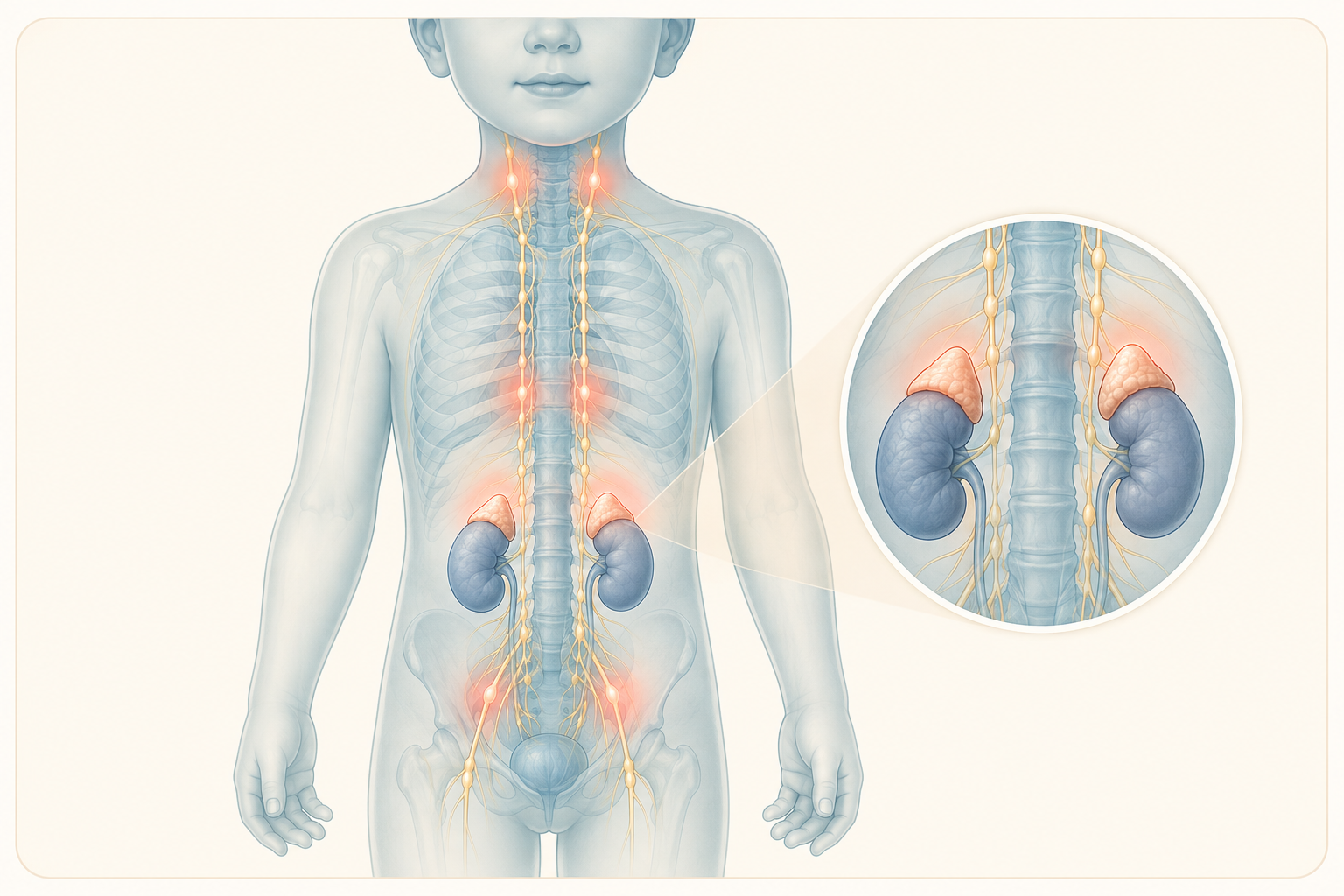
Neuroblastoma is a cancer that develops from immature nerve cells. These cells are part of the sympathetic nervous system, which helps control automatic functions such as heart rate and blood pressure.
The tumour most commonly begins in the adrenal gland, a small gland located above the kidney. It can also arise alongside the spine in the abdomen, chest, neck or pelvis.
Neuroblastoma mainly affects babies and young children, and most cases are diagnosed before five years of age. It behaves very differently from one child to another. Some tumours remain localised and are cured with surgery alone. Some may shrink without intensive treatment, particularly in very young infants. Others are more aggressive and require several forms of treatment.
This wide variation is why the word neuroblastoma alone does not tell us the full story.
**What causes neuroblastoma?**
In most children, there is no identifiable cause. It is not caused by something a parent ate, did or failed to do during pregnancy. It is also not usually related to diet, lifestyle or an infection.
Most cases are not inherited. A small number are associated with inherited genetic changes, and the treating team may recommend genetic counselling or testing when the child’s age, family history or tumour pattern suggests it.
**What symptoms can it cause?**
The symptoms depend on where the tumour begins and whether it has spread.
**Possible signs include:**
A lump or swelling in the abdomen
Abdominal pain, poor appetite, early fullness or weight loss
Constipation or difficulty passing urine
Bone pain, limping or refusal to walk
Persistent tiredness, paleness or unexplained fever
Bruising around the eyes or prominent eyes
Weakness or reduced movement of the legs, particularly if a tumour is pressing near the spinal cord
A drooping eyelid or a smaller pupil on one side
High blood pressure, sweating, flushing or a fast heartbeat
Rarely, rapid dancing eye movements with jerky body movements, known as opsoclonus-myoclonus syndrome
These symptoms are much more commonly caused by conditions other than cancer. However, a persistent abdominal lump, unexplained bone pain, progressive weakness or symptoms that do not settle should be assessed promptly.
**How is neuroblastoma diagnosed?**
The evaluation usually happens in stages. The team may advise:
**Blood and urine tests**
Many neuroblastomas produce chemicals called catecholamines. Their breakdown products, commonly VMA and HVA, can often be detected in urine. Blood tests also assess the child’s general health, blood counts, liver and kidney function, and other markers that may help with risk assessment.
**Imaging**
An ultrasound may be the first scan, especially when an abdominal mass is found. CT or MRI provides a more detailed picture of the tumour, nearby organs, blood vessels and the spinal canal.
An MIBG scan uses a small amount of radioactive tracer that is taken up by most neuroblastoma cells. It helps identify disease elsewhere in the body. In selected situations, other imaging such as a PET scan may be used.
**Biopsy**
A tissue sample is usually needed to confirm the diagnosis. The pathologist examines the cells under a microscope and performs tests that help reveal how the tumour is likely to behave.
**Bone marrow tests**
Bone marrow aspiration and biopsy may be required to check whether the disease has spread to the marrow.
**What do stage and risk group mean?**
Parents often hear several terms at once: stage, risk group, tumour biology and genetic markers. They are related, but they are not identical.
The stage describes where the tumour is and how far it has spread. The risk group helps predict how the tumour may behave and guides the intensity of treatment.
**Risk assessment may consider:**
- The child’s age at diagnosis
- The tumour’s location and extent
- Whether it has spread
- Whether surgery can be performed safely
- How the cells look under the microscope
- Genetic and molecular features, including changes involving the MYCN gene
- The number and pattern of chromosomes within the tumour cells
Children are broadly classified into low-, intermediate- or high-risk groups. Two children with neuroblastoma may therefore receive very different treatment plans, and both plans may be appropriate.
**What is the role of surgery?**
Surgery has an important role in diagnosing and treating neuroblastoma, but the safest timing differs from child to child.
For a small, localised tumour, surgery may remove the entire tumour and may be the only treatment required. For a larger tumour involving or surrounding major blood vessels, chemotherapy may be given first to shrink it and make surgery safer.
The aim is not simply to remove every visible cell at any cost. Neuroblastomas can wrap around important arteries, veins, nerves or organs. A carefully planned operation balances tumour removal with the risk of major complications. In some children, leaving a small amount of tumour attached to a vital structure can be safer than attempting a dangerous complete removal. The rest of the treatment plan is designed with this possibility in mind.
The operation may be performed through an open incision or, in selected localised tumours, using minimally invasive surgery. The approach depends on the tumour’s size, position, relationship to major vessels, the child’s age and the surgeon’s assessment.
**How is neuroblastoma treated?**
Treatment is based on the risk group and may include one or more of the following:
**Observation**
Some carefully selected infants with favourable tumours may be monitored closely because the tumour can mature or shrink naturally. Observation is an active medical plan with scheduled examinations and scans, not an absence of care.
**Surgery**
Surgery may provide tissue for diagnosis, remove a localised tumour, or remove the remaining primary tumour after chemotherapy.
**Chemotherapy**
Chemotherapy is used when the tumour cannot initially be removed safely, when it has spread, or when its biology indicates a higher risk of recurrence.
**Radiation therapy**
Radiation is used in selected cases, especially in high-risk disease or when local control is needed after other treatments.
**High-dose chemotherapy with stem-cell rescue**
This may form part of treatment for high-risk neuroblastoma. The child’s own blood-forming stem cells are collected and stored, then returned after high-dose chemotherapy.
**Immunotherapy and differentiation therapy**
Immunotherapy can help the immune system recognise and attack remaining neuroblastoma cells. Isotretinoin, a medicine related to vitamin A, encourages residual tumour cells to mature and is used in high-risk treatment protocols.
**MIBG therapy and newer treatments**
Radioactive MIBG can deliver radiation directly to neuroblastoma cells in certain children. Targeted medicines and clinical trials may also be considered, particularly for persistent or recurrent disease.
**Can neuroblastoma be cured?**
Yes, many children with neuroblastoma are cured. Children with localised, low-risk disease generally have an excellent outlook. High-risk neuroblastoma is harder to treat and requires prolonged, intensive therapy, but treatment has continued to improve.
A prognosis cannot be estimated responsibly from the stage alone or from figures found online. It depends on the child’s age, risk group, tumour biology, response to treatment and several other factors. The treating team is best placed to explain what the available information means for one particular child.
What should parents ask the treating team?
It can help to write down questions before appointments. Useful questions include:
- Where did the tumour begin, and has it spread?
- What is my child’s stage and risk group?
- Which biological or genetic test results are important?
- Is a biopsy required, and how will it be performed?
- Should surgery happen now or after chemotherapy?
- What is the aim of the operation?
- Which major blood vessels, nerves or organs are close to the tumour?
- What treatments are recommended, and in what sequence?
- What short- and long-term side effects should we expect?
- How will response to treatment be measured?
- Is a clinical trial appropriate?
- Who should we contact if our child develops a problem between visits?
**A final word for families**
A diagnosis of neuroblastoma can make life feel as though it has changed overnight. Try to take the process one step at a time. Ask the team to repeat or explain anything that is unclear. Keep copies of scan reports, biopsy findings, treatment summaries and discharge records. If the treatment plan is complex, seeking a second opinion from a paediatric cancer centre is reasonable and should not be seen as a lack of trust.
Most importantly, parents should know that they did not cause this illness. Your child’s care should be planned by a multidisciplinary team experienced in childhood cancer, including paediatric oncologists, paediatric surgeons, radiologists, pathologists, radiation oncologists, nuclear medicine specialists, specialised nurses and supportive-care professionals.
Dr Vinayak Rengan is a pediatric surgeon in Chennai, India who specilaises in treating pediatric solid tumours including neuroblastoma. You may email him regarding a consult or second opinion.
For a consultation or an opinion regarding a child with a suspected or diagnosed tumour, you may contact:
**Dr Vinayak S. Rengan
Paediatric Surgeon | Paediatric Surgical Oncology
Email: vinayak.rengan@gmail.com**
This article is intended for general education and cannot replace an individual medical consultation. If a child is acutely unwell, has new weakness, breathing difficulty, severe pain or rapidly worsening symptoms, seek urgent medical care.
Use the resource https://childcancerplanner.com/
To help you understand more about neuroblastomas
This article is for general educational purposes and is not a substitute for personalised medical advice.